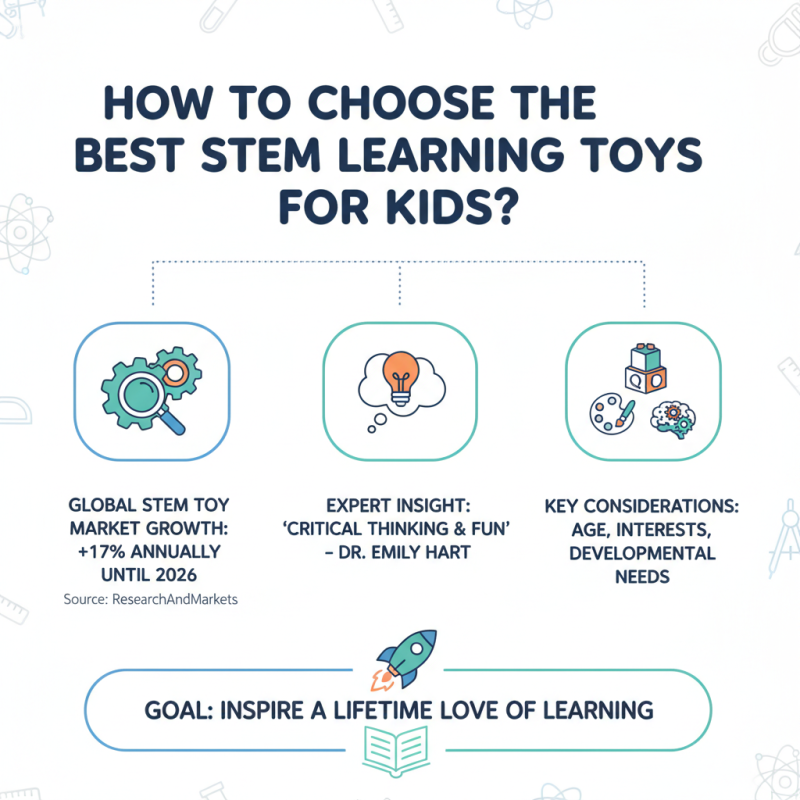
The rise of STEM (Science, Technology, Engineering, Mathematics) Learning Toys is reshaping children's education. According to a recent report by ResearchAndMarkets, the global STEM toy market is projected to grow by over 17% annually until 2026. This surge indicates a growing recognition of the importance of early STEM education.
Dr. Emily Hart, an education expert in this field, commented, "STEM Learning Toys are not only fun but also essential in developing critical thinking." Parents are now challenged with selecting the right toys that promote engagement and learning. Many products claim to be educational, but not all deliver meaningful experiences.
Choosing the best STEM Learning Toys requires more than just popularity. Consider a child’s age, interests, and developmental needs. Closely examining the quality and educational value can lead to better outcomes. After all, the goal is to inspire a love of learning that lasts a lifetime.
STEM toys play a crucial role in child development. They enhance creativity, critical thinking, and problem-solving skills. Children engage in hands-on learning while having fun. This combination can spark a lifelong interest in science, technology, engineering, and math.
When children build a simple robot, they learn about mechanics. While solving puzzles, they develop logical reasoning. These toys encourage exploration and experimentation. However, not every child responds the same way. Some may feel frustrated by complex tasks. That's a normal part of the learning process.
Choosing the right STEM toy requires understanding a child’s interests. A child drawn to art may prefer design-focused toys. Others might enjoy coding games. Parents should reflect on their child’s strengths and challenges. It's a journey, and sometimes the journey is messy. But through trial and error, meaningful growth happens.
Choosing age-appropriate STEM learning toys is crucial for nurturing young minds. Research indicates that children engage better when toys align with their developmental stages. For toddlers, focus on toys promoting basic motor skills. Building blocks or simple puzzles can stimulate their problem-solving abilities. According to the American Educational Research Association, play enhances cognitive development significantly during early childhood.
As kids grow, around ages 5 to 8, look for toys that introduce basic coding or robotics. At this stage, engagement drives learning. Statistics show 80% of children enjoy hands-on experiences, which reinforce STEM concepts. Educational kits that encourage creativity will also spark curiosity. However, some parents overlook their children's interests and may purchase toys that are too advanced or simplistic, missing the balance needed for effective learning.
For ages 9 and up, the focus shifts to critical thinking and collaboration. Team-based projects and science kits that require experimentation can be beneficial. A report from the National Science Foundation suggests that peer interactions stimulate deeper learning. Nevertheless, too many choices can overwhelm kids, leaving them disengaged. Parents should encourage exploration but remain mindful of their preferences.
When choosing STEM learning toys for kids, several key features deserve attention. Look for toys that encourage
problem-solving skills. Building kits that require assembly can spark creativity. Kids learn best when they engage with hands-on activities.
Look for toys that challenge them but are not overly complex. Simplicity in design can lead to better understanding.
Another important feature is the
age appropriateness of the toy. Many toys specify age ranges, but parents should consider individual development.
A toy that’s too advanced can lead to frustration. Conversely, a toy that is too simple may not hold their interest. Striking the right balance is crucial.
Lastly, consider the
materials used. Toys made of durable, non-toxic materials are essential. They ensure safety and longevity. Many kids can be rough with their toys,
so they need to withstand play. However, not all toys are built equally. Reflect on how your child interacts with different materials. Observing their preferences can guide
better choices in the future.
When choosing STEM learning toys, safety is crucial. The materials used in these toys can impact children’s health. A report by the U.S. Consumer Product Safety Commission shows that over 250,000 toy-related injuries occur each year. Parents must ensure that products meet safety standards. Look for toys labeled as non-toxic and BPA-free. These materials help reduce the risk of harmful exposure.
Consider the age appropriateness of the toy. Some STEM toys may contain small parts, posing a choking hazard for younger kids. Always check ratings and recommendations. Toys should align with your child’s developmental stage. Check for certifications from trusted organizations that evaluate safety. Knowledge is power here.
Tip: Read the packaging for safety information. Not all toys are created equal. Some may seem educational but lack quality and safety. Researching can avoid unpleasant surprises.
Another important aspect is the toy’s design and usability. A toy should be engaging, but also easy to understand. Complex toys may frustrate children, leading to disinterest. Look for features that encourage creativity and exploration without overwhelming them.
Engaging kids with STEM learning toys can spark their curiosity and creativity. Research shows that hands-on learning enhances understanding. According to a study by the National Science Foundation, children learn better through physical interaction. They become more motivated. When kids are engaged, they retain information longer.
Choosing the right toys plays a crucial role. Look for items that challenge problem-solving skills. Puzzles and building kits can offer this. A report from the Journal of Educational Psychology suggests that children exposed to STEM toys develop critical thinking and analytical skills. Allowing kids to explore freely encourages innovation.
It’s essential to reflect on how toys are used. Not all toys will resonate with every child. Some might find coding kits intimidating. Others might be less interested in robotics. Awareness of these differences helps in fostering a supportive learning environment. Encourage open dialogue about their experiences. Their feedback can guide future choices.
: STEM toys enhance creativity, critical thinking, and problem-solving skills. They promote hands-on learning.
Building a robot teaches mechanics and encourages exploration. It can spark an interest in science and technology.
Understand your child's interests. Consider their strengths and challenges when selecting a toy.
Focus on toys that promote basic motor skills, like building blocks. Simple puzzles can also stimulate problem-solving.
Around ages 5 to 8, look for toys that introduce these concepts. Engagement is key for effective learning.
For ages 9 and up, focus on toys that encourage critical thinking and collaboration, but avoid overwhelming choices.
Look for toys that encourage problem-solving and creativity. They should also be age-appropriate to prevent frustration.
Durable and non-toxic materials ensure safety and longevity. Observing how your child interacts with materials is helpful.
Yes, a toy that's too simple may not engage them, while one that's too advanced can cause frustration.
Some overlook their child's interests, leading to purchasing toys that don’t fit their developmental stage or preferences.
STEM Learning Toys play a crucial role in child development by fostering skills in science, technology, engineering, and mathematics. These toys not only encourage curiosity and problem-solving but also prepare children for future educational paths. When selecting STEM toys, it is essential to consider the child's age, ensuring that the toys are suitable for their developmental stage.
Key features to look for include engaging designs, versatility, and the potential to stimulate creative thinking. Additionally, evaluating safety standards and materials is vital to ensure that the toys are safe and durable for use. To maximize the benefits of STEM Learning Toys, parents and educators can adopt strategies that promote engagement and creativity, transforming playtime into a rich learning experience.
Cart Toys